Showing posts with label Letterboxing. Show all posts

Saturday, November 17, 2007

Caching, Maggie Smith, And The Loch Ness Monster: The Conclusion

If you've been reading this past week, you should now know all about Geocaching, Letterboxing, Maggie Smith's bench, and my Loch Ness Monster sighting. And with this information, my post from November 12th should now make perfect sense. (If you haven't read all those, feel free to go read them now. I'll wait.)

Ok, every one caught up? So, now that you know what I'm talking about, I'll finish the story.

As I said, I'd seen what I thought were cachers in the park a few days earlier. But I hadn't approached them because they looked like they were trying to be discrete. Plus, I wasn't completely sure that's what they were doing, though I was pretty sure. They were even carrying a Ziploc bag ;) But I didn't see them carrying a GPS. When I later discovered that they'd been searching for a Letterbox and not a Geocache, the lack of a GPS made sense -and also explained why there'd been no listing for it on the Geocaching website!

I returned a few days later with my stamp, book, and ink pad in hand; retrieved the Letterbox, stamped my book with its stamp and stamped the Letterbox's pad with my own stamp. The Letterbox's pad was so small that a gentleman walking his dog thought I was writing directly onto the palm of my hand and stopped to ask if I was writing crib notes ;)

This was actually my first Letterbox that wasn't a Geocache/Letterbox hybrid. I've never hunted for a pure Letterbox using only clues and a compass without any GPS info, but now that I've discovered that many are hidden close to my home, I may have to give some a try. I'll admit I'm a bit intimidated by this thought. The last time I looked at a set of Letterbox clues they were hard!

If you're in New York and would like to search for this Letterbox, I tracked down the corresponding clues for it online and they're quite easy. Nothing cryptic, and no puzzle solving or compass required! Just go to this page at letterboxing.org and click on the Letterbox called "Stumped."

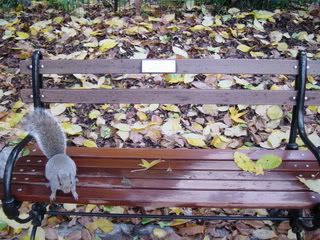
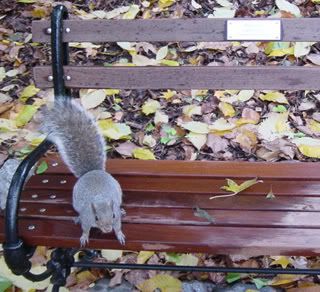
I can't show you pictures of the Letterbox's exact location or its contents because that would be against the rules of the game, but this guy might tell you...

Squirrel On Bench


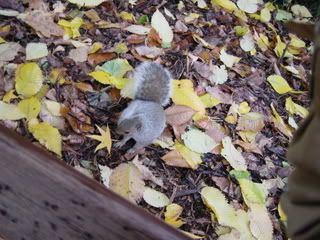
When I returned to stamp the Letterbox, I also came prepared for him this time.

Squirrel By Bench


Squirrel By Bench


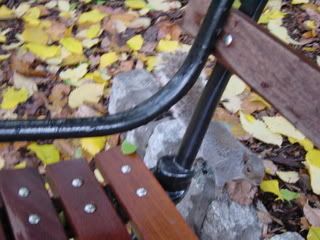
Squirrel On Bench

And yes, I "paid his toll."

Squirrel Eating Peanut In Tree


Thursday, November 15, 2007

What Is Letterboxing?

Letterboxing is a game that started in Europe in the 1850s. The earliest known USA Letterboxes date back to the 1980s/1990s.

How Does Letterboxing Work?

Letterboxing is similar to Geocaching. All over the world, people hide small containers (called Letterboxes) which contain a log book and a rubber stamp. But unlike Geocaching, which uses GPS coordinates to find a cache, with Letterboxing people follow cryptic clues to find the Letterbox. These clues often involve riddles, puzzles, descriptions of landmarks, and instructions to walk a certain number of paces in a given direction. Another difference between Letterboxing and Geocaching is that with Geocaching, people swap items, but with Letterboxing, people swap stamp impressions.

What Equipment Do I Need To Letterbox?

The first thing you'll need is a rubber stamp which will serve as your "signature stamp." Your stamp should be a picture of something that you feel represents you. It can be anything: An animal, a symbol, a fancy design... Purists carve their own stamps or commission them from companies so that each person's stamp is unique, but you can use one from a store if you'd like.

In addition to your personal stamp, you'll also need a set of clues, an ink pad, a pen, a blank book or pad to collect stamp impressions from your various finds, and sometimes you may need a compass.

What Do You Do Once You Find A Letterbox?

As with Geocaching, discretion is key. You must make sure that nobody sees you retrieving or replacing the
Letterbox. When you find a Letterbox (and remember that Letterboxes only contain a stamp and a small pad or book, so the containers may be quite small.) have a seat with it somewhere nearby so as not to draw attention to its exact location.

Use the stamp from the
Letterbox to stamp your personal book and use your pen to make a small notation in your book about that particular stamp (like the date, location, and any other notes you might want to jot down etc.) Next, use your own stamp to stamp the Letterbox's log book and write a small note identifying yourself and the date of your find. Then take a moment to look back through the log book and see the stamps from all the other eccentrics very nice people who've come before you.

When you're done, put the
Letterbox (with its original stamp and log book) back where you found it. Remember, with Letterboxing you do not swap items. The only thing you're trading is stamp impressions. The Letterbox should be put back with its original stamp and book, and you should be leaving with the stamp and book you brought with you.

Are There Geocaches That Are Also Letterboxes?

Yes! Some
Geocaches are also Letterboxes. If a Geocache is also a Letterbox, it will say so in the description so you know to bring along your stamp, ink pad, and book. For Geocache/Letterbox hybrids the rules for trading stamp impressions are the same, but the clues to find it will include GPS coordinates.

Where Can Clues To Letterboxes Be Found?

Traditionally, clues to
Letterboxes were passed amongst other Letterboxers in a kind of "secret society" manner. Nowadays there are publications listing the various locations of Letterboxes in Europe, and of course there's now also the Internet.

Unlike Geocaching, there is no worldwide
Letterboxing website, but a good place to start is Letterboxing North America. Their site is pretty comprehensive and can give you a good overview of Letterboxing. If you don't live in North America, read their site anyway (and be sure to check their Map Page for some International listings.) When you're finished try Google for additional Letterbox locations.


Wednesday, November 14, 2007

What Is Geocaching?

Geocaching is a game that started in the USA in the year 2000. It's very similar to Letterboxing, except that GPS coordinates are used instead of hints, and real objects are swapped instead of stamp impressions. I've been Geocaching since 2002 and it's one of my favorite things to do outdoors.

Yeah But What Is It?

It's a sport, it's a game, it's how geeks experience nature :) It's a treasure hunt that's taking place all over the world. Even where you live! -And you probably didn't even know it.

Here's How Geocaching Works:


All over the world, people have hidden "caches." A cache is basically a small collection of objects, usually small inexpensive things like keychains, refrigerator magnets, or small toys. These are usually hidden in small waterproof containers like Tupperware, or small plastic Ziploc bags. Once a cache has been hidden, its coordinates (latitude and longitude) are uploaded to the Geocaching website.

Later, another individual (let's say YOU) logs onto the Geocaching website and types in their postal code or city and country. When they do so, a list of caches in their area pops up on the screen with coordinates and occasionally some additional clues. You copy down all the relevant information, grab your GPS unit and go!

What's A "GPS Unit?"

GPS stands for "Global Positioning System." You've probably heard about them being used in cars to help people navigate to where they're going, but there are also smaller handheld versions that hikers use. That's the kind you'll need. You can pick up a small GPS unit for $100 or so and even cheaper if you find a used one. There are also modules that snap onto Palm Pilots and convert them into GPS units. That's what I use.

Once you have your GPS unit in hand, you type in the coordinates for the cache you're seeking, your GPS unit makese a few calculations, then it shows you how far you are from the cache. It will also display an arrow indicating which direction you need to walk to get closer. As you walk, the GPS unit will continuously update this information. Just walk in the direction of the arrow and make sure your distance from the cache keeps decreasing (if it's increasing you're walking the wrong way!)

Here's the thing though... your GPS unit will get you close, VERY close, but will rarely lead you to the exact spot. When you're really close, the unit's readings will often start jumping around a lot. At that point you're probably within 10 to 20 feet of the cache location. 10-20 feet in all directions can be a lot of ground to cover when you're looking for a small container. And many of them are very well hidden! They have to be so that Non-Geocachers (Sometimes called "Muggles") won't stumble across them by accident. It takes me anywhere from about 5 minutes to one hour to find a cache once I reach the correct location. Once in a rare while, I won't be able to find it at all.

About "Reaching The Correct Location..."

Reaching the correct location is not always as easy as it may seem. To get to the cache coordinates, you'll probably be led on some interesting walks and discover nature paths you never even knew existed. Sometimes mountain climbing skills are in order. Once I needed a boat. Generally the cache description page will give you an idea of how easy or difficult it should be to reach the cache location and will let you know if you'll need any special skills or equipment. Most are quite easy though. Well.... easy to get to, but maybe not always so easy to find once you're there!

What Do You Do Once You Find The Cache?

First make sure nobody else is around. This all has to be done without Non-Cachers seeing what you're doing. Then, when nobody's looking, take the cache container a bit away from where you found it, so as not to give away its location, and have a seat. Open the cache and take a look at what's inside. Next, take one of the objects to keep for yourself, and swap in one of your own (-another magnet, keychain, action figure...). Then sign the "log book" that's usually enclosed in the container and take a moment to read the entries of all the other geeks very nice people that came before you. Then, when nobody's looking, put everything back exactly the way you found it. Then go home, log onto the Geocaching website and say "I FOUND IT!" :) and go look for more!

Geocaching is fun, and it's a really a great way to get outdoors and discover new and beautiful places. I know... You're thinking there's nothing like that where YOU live right? You're wrong! There are caches near you. Don't believe me? Take a look!


The Groundspeak Geocaching Logo is a registered trademark of Groundspeak, Inc.
Used with permission.


 

Monday, November 12, 2007

Caching, Maggie Smith, And The Loch Ness Monster

Ok, so first of all I went out to do laundry and go to the bank, but the bank was closed. So I decided to go on my walk because the other day I swore I saw cachers but they were trying to be discrete so I didn't bother them, so I'd gone home and was going to leave them a message except I couldn't find a cache listing so I'd planned to go back and see which one it was, because I know all the caches in that park, and so I went back today but there were muggles in the area, so I sat down on Maggie Smith for a while and then this squirrel came up to me because apparently if you're going to sit on Maggie Smith you need to pay a toll, and I explained to him that I hadn't realized this and therefore had nothing for him (because I knew Maggie Smith liked baby birds but no one said anything about squirrels) but he didn't seem to understand this and sat right next to me waiting, and I showed him both sides of my hands to see if that would help (because I figured that was the universal language for "I have no food!"), but by now there was no one around so I went back to where I expected to find the cache and ANOTHER squirrel came up to me (because apparently you have to pay a toll there too!) and I found the cache and went back to sit on Maggie Smith, accompanied by the troll under the bridge squirrel, and it was a letterbox! But I didn't bring my stamp, so I put everything back, said goodbye to the squirrels and proceeded on my walk where I saw the Loch Ness Monster and...

What? Did I lose some of you? Yeah... maybe some background information? Ok... I'll write about that in the next few days and I promise you when I'm done everything will be 100% perfectly clear. But I can't do that right now because I have to go switch loads and buy some nuts.

(No I'm not on drugs! :p)